
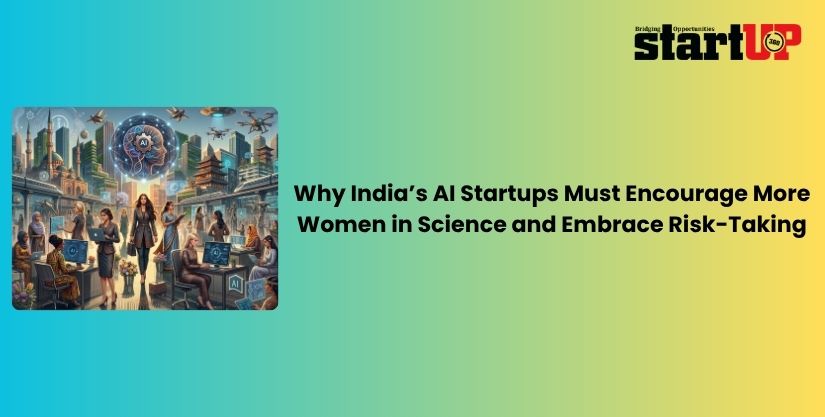
Why India’s AI Startups Must Encourage More Women in Science and Embrace Risk-Taking
Introduction
India’s artificial intelligence (AI) startup ecosystem is growing at an unprecedented pace. With increasing investments, government support, and global attention, the country is positioning itself as a future AI powerhouse. However, two critical gaps continue to limit its full potential: the underrepresentation of women in science and a lack of a strong risk-taking culture within startups. Addressing these challenges is not just a matter of inclusion; it is essential for innovation, resilience, and long-term success.
The Gender Gap in India’s AI Ecosystem
Despite progress in education, women remain underrepresented in STEM (Science, Technology, Engineering, and Mathematics) fields in India. This gap becomes even more visible in AI startups, where leadership roles and technical positions are predominantly held by men.
Encouraging more women to participate in science and AI brings diverse perspectives, which are crucial for building inclusive technologies. AI systems influence everything from hiring decisions to healthcare and financial services. Without gender diversity, there is a higher risk of biased algorithms and limited problem-solving approaches.
Bringing more women into AI startups can:
- Enhance creativity and innovation
- Reduce bias in AI models
- Improve decision-making processes
- Create a more inclusive work culture
Why Women in Science Matter for AI Innovation
AI thrives on diverse datasets, ideas, and perspectives. Women scientists and engineers bring unique insights shaped by different life experiences. This diversity helps in designing AI solutions that are more balanced and relevant to a wider population.
For example, in sectors like healthcare, education, and social impact, women-led innovations often focus on accessibility and user-centric design. Including more women in AI development ensures that products are not just technically advanced but also socially responsible.
Moreover, empowering women in science creates a ripple effect, encouraging future generations of girls to pursue careers in technology and innovation.
The Importance of Risk-Taking in Startups
Startups, by nature, thrive on risk. However, many Indian AI startups tend to adopt a cautious approach, focusing on proven models rather than experimenting with bold, disruptive ideas.
A strong risk-taking mindset is essential for:
- Driving breakthrough innovations
- Competing on a global scale
- Attracting investors looking for high-growth potential
- Building scalable and future-ready solutions
Without calculated risk-taking, startups may struggle to move beyond incremental improvements and fail to achieve significant impact.
Building a Culture of Smart Risk-Taking
Risk-taking does not mean reckless decisions. It involves strategic thinking, data-driven experimentation, and the willingness to learn from failure.
Indian AI startups can strengthen their risk culture by:
- Encouraging experimentation and innovation
- Creating safe environments to fail and learn
- Investing in research and development
- Supporting bold ideas from diverse teams
- Learning from global startup ecosystems
When combined with diverse talent, especially women in science, this approach leads to more balanced and effective decision-making.
The Intersection of Diversity and Risk Thinking
Interestingly, diversity and risk-taking go hand in hand. Teams with varied backgrounds tend to evaluate risks more comprehensively and make better strategic decisions. Women leaders, in particular, often bring a balanced approach to risk, combining caution with long-term vision.
This combination can help AI startups:
- Avoid blind spots in decision-making
- Develop more sustainable business models
- Navigate uncertainties with greater confidence
By fostering both gender diversity and a strong risk mindset, startups can build a more resilient and innovative ecosystem.
The Way Forward for India’s AI Startups
To unlock their full potential, Indian AI startups must take deliberate steps to promote inclusivity and innovation:
- Encourage STEM education for women through scholarships, mentorship, and awareness programs
- Promote women’s leadership in AI and tech roles
- Build inclusive workplace cultures that support diversity
- Adopt bold innovation strategies with calculated risks
- Collaborate with academia and industry to nurture talent
Government initiatives, corporate policies, and startup founders all have a role to play in shaping this future.
Conclusion
India stands at a pivotal moment in its AI journey. To truly become a global leader, the ecosystem must go beyond funding and technology; it must embrace diversity and courage.
Encouraging more women in science and fostering a strong culture of risk-taking are not optional strategies; they are essential drivers of innovation. By combining inclusive talent with bold thinking, India’s AI startups can unlock new opportunities, solve complex challenges, and lead the world in meaningful technological advancements.